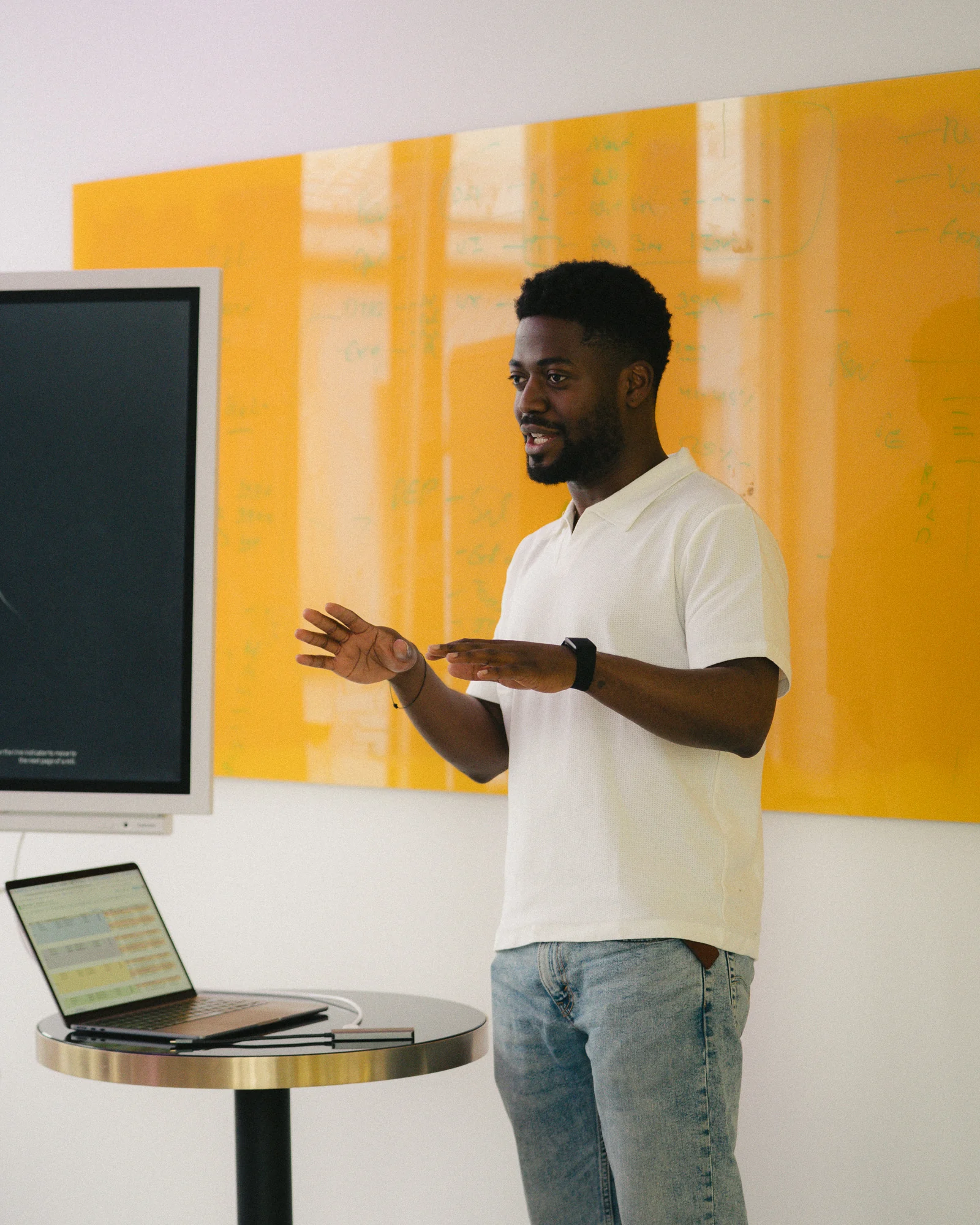
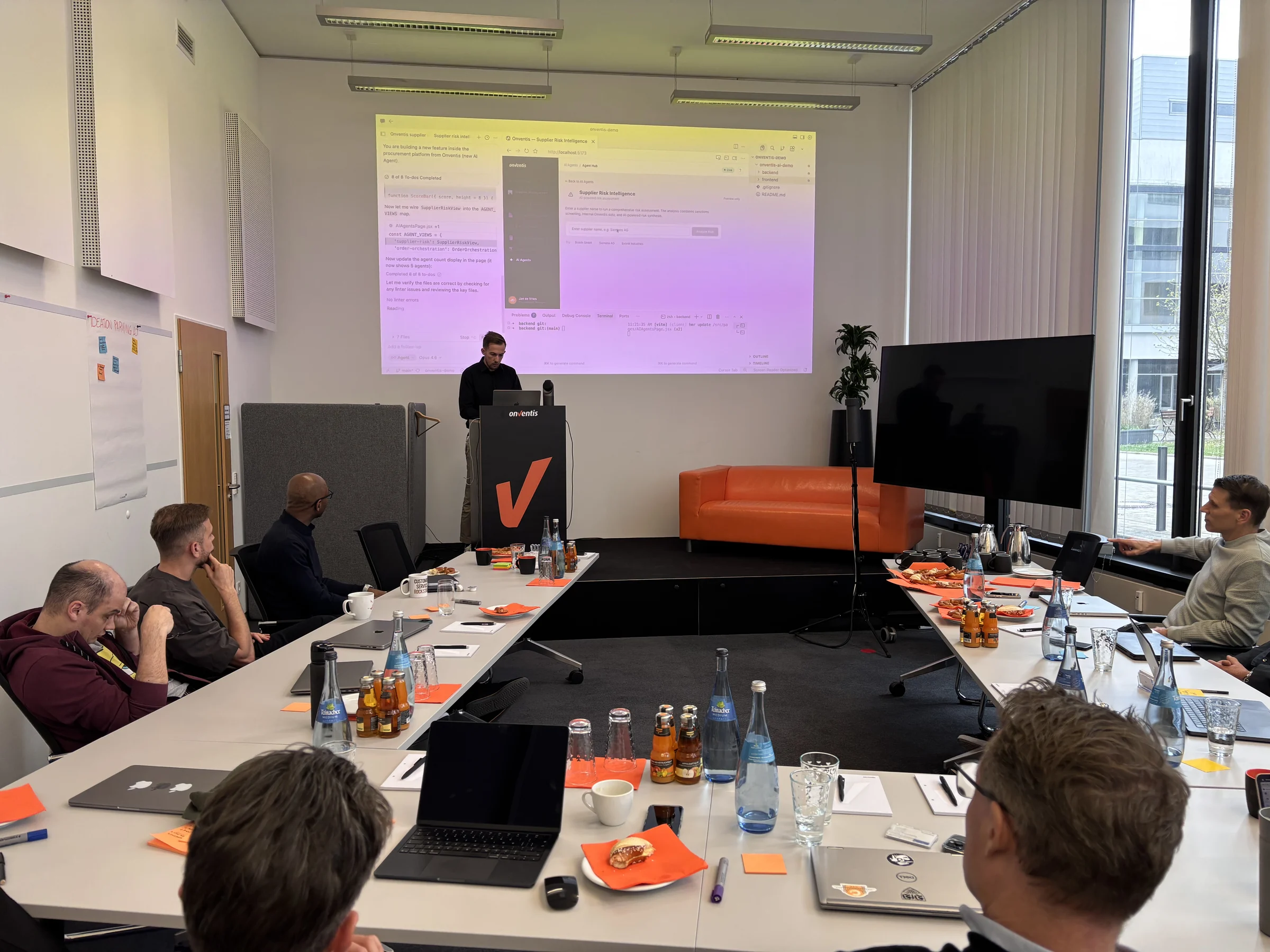
AI Workshop for SMBs and Mid-Market Companies, One Day Onsite
Without an IT department, AI often stays stuck at a few employees trying ChatGPT on their own while daily business runs exactly as before. An AI workshop brings the team together onsite for one day and builds on the most urgent task in your own business, without stopping daily operations. Need more afterward, you move on to the multi-day Corporathon hackathon.
Where SMBs and mid-market companies get stuck with AI. Without an IT department, AI often stays stuck at a few employees trying ChatGPT on their own while daily business runs exactly as before. An AI workshop
The format
Knowledge turns into a working prototype.
An AI workshop for SMBs and mid-market companies without an IT department, one day onsite with a result you use right away. Book a discovery call.
01
Where SMBs and mid-market companies get stuck with AI
Without an IT department, AI often stays stuck at a few employees trying ChatGPT on their own while daily business runs exactly as before. An AI workshop brings the team together onsite for one day and builds on the most urgent task in your own business, without stopping daily operations. Need more afterward, you move on to the multi-day Corporathon hackathon.
02
What mid-market teams build
Typical challenges: a quoting assistant that prepares structured offers from inquiries, a customer service bot for recurring questions, a knowledge bot with n8n and Claude Code that documents and keeps accessible the experience of long-tenured staff, plus a reporting tool with Gamma for leadership. Built with Lovable, n8n and Custom GPTs, with no coding background required.
03
One week to your hackathon
1. Intro call, clarify goal and team. 2. Tools and challenges call, pick the most urgent task. 3. Finalize data and access. 4. Prepare the environment. 5. Hackathon days, tool workshop, sprint, result pitches.
04
Classic training vs. Corporathon
A training shows leadership AI in theory. The AI workshop delivers the quoting assistant in one day, running in daily business the following week. That is what justifies the investment for a smaller business, and the hackathon deepens it afterward if needed.
Output, not slides
A hackathon is not a seminar. It is a facilitated sprint where teams rebuild real work with AI.
0 week
from scope to ready-to-run sprint
0 formats
Spark, Ignite and Blaze
0 steps
from call to documented handoff
How it works
Clear steps from scope to handoff.
01
Intro call
Corporathon + sponsor · goal, scope and date
02
Challenge design
Corporathon + team leads · real use cases and tool stack
03
Data & access
Client · approved data, roles and boundaries
04
Tool workshop
Corporathon · teams can use the stack
05
Hackathon sprint
Teams · working prototypes
Next step
Ready for your hackathon?
Book a discovery call directly, we clarify goal, format and date in the call.
The calendar loads external content from Cal.com. Click to load it, or accept "functionality" in the cookie settings so it loads automatically next time.
FAQ
Questions that should be clear before the first call.
An AI workshop for SMBs and mid-market companies without an IT department, one day onsite with a result you use right away. Book a discovery call.
Usually not for smaller formats. As soon as production systems are connected, we bring IT and security in early.
There is no proof of participation at the end, there is a working result: built workflows that keep running in daily operations.
For teams in marketing, sales, operations, product and IT. Coding skills are not required, the facilitation is built so every team ships a working prototype.
Usually one week: scoping call, use-case selection, access and tool setup. After that the sprint is ready to run.
You decide which data enters the sprint. Access, privacy and boundaries are agreed upfront and we only work with approved material.
You do. Prototypes, automations, workflows, prompts and generated code belong to your company after the sprint.
We work with the stack that fits you: LLM APIs, automation and data platforms, and your existing systems.
Teams of four to six work best. Overall we run everything from a single team up to several dozen participants.
All three work. On site creates the strongest momentum, remote is leaner logistically, hybrid is the usual compromise for distributed sites.
You get a documented handoff: prototypes, setup, open items and a recommendation on which results deserve to go to production.